I don't remember the first time I saw an atom, but I do remember the first time we studied them in science class, and they fascinated me. Their complexity in the drawings they showed us, and how they could join together and form substances, made me want to know more: I read a lot about them, about their place in the periodic table, their particles, and even about how they were used to generate the energy in our homes.
Much later I learned to program, and I wanted to reflect what I had learned in classes and books. I wanted to create an atom, watch it move, make each of its parts seem real; combine them and, perhaps, build something bigger in a simulator. But something unexpected happened: I was no longer a curious youngster, but an adult with a different way of thinking. So I started investigating from scratch. And the result was surprising: after years of reading books on the subject, just a few hours of critical thinking were enough to reveal details I had not seen before.
Early studies
Although the accounts vary greatly, almost all of them trace back to ancient times and look quite like this one:
"They say that the first studies of atoms date back to ancient times, when the most studious wondered into how many parts everything could be divided. After long study they concluded that things could be divided only up to a limit, leaving at the end fragments so small and imperceptible that they called them atoms."
The atom in ancient times
To grasp the idea, imagine you are incredibly bored and you grab anything divisible —a toothpick, a leaf, a piece of fruit— and split it in half. And again. And again… until you just can't anymore. And there you have it: you've got an atom! …or so the idea went, at least.
If we could stop time and stick with this story, I could build my simulator without trouble: I'd just make an apple split into two, into three…, set a limit, and done. But this was only the beginning of the story.
The evolution of the atomic model
What follows is the by-product of a deep study of historical facts and discoveries that gradually shaped what we today call atoms.
At the beginning of the 19th century, a British chemist named John Dalton, in the absence of the periodic table and of symbols to represent the chemical elements, created his own system of graphic representation. Essentially, he made a list of the known elements —gold, silver, carbon, oxygen...— and drew a circle beside each one with a different design inside so as to tell them apart.
Dalton conceived of atoms as tiny, solid, indivisible spheres, which he commonly called "ultimate particles", something like the limit of matter, where it could no longer be divided. His work managed to join, once and for all, the abstract concept of the atom with chemical experimentation, which is why he is historically recognized as the father of atomic theory.
Almost a century later, another British scientist named Joseph John Thomson, trying to explain the nature of cathode rays, argued that they were made up of tiny corpuscles carrying electricity. To explain where such particles came from, he argued that they lived inside atoms, something like the raisins in a pudding, and even built an atomic theory based on that plum pudding.
Thomson's atomic model
It is worth noting that Thomson never showed the world a single one of those corpuscles: he deduced them from his experiments, he did not see them. Even so, the idea was awarded the Nobel Prize in 1906 and was etched in as a fact. From then on, the atom stopped being a modest hypothesis and became something no one dared to question. These events completely changed the rules of the game for the scientists of the time, turning the atom and its theories into a sure springboard to success.
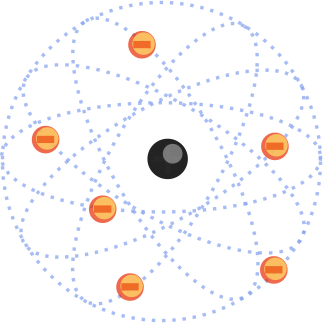
Years later, a New Zealand scientist named Ernest Rutherford also connected his research on radioactivity with atoms, and argued that they were not static like Thomson's pudding, but something very much like a miniature solar system. He also added a new piece —a tiny nucleus where almost all the mass was concentrated— and built a new atomic theory upon it.
Rutherford's atomic model
The new planetary atomic model was something like a very small, positively charged nucleus, around which negatively charged particles (the electrons) orbited, forming a kind of orbital system. The third piece, the neutron, did not yet appear: it would not show up until 1932. For his research on radioactive substances, Rutherford earned a Nobel Prize in 1908.
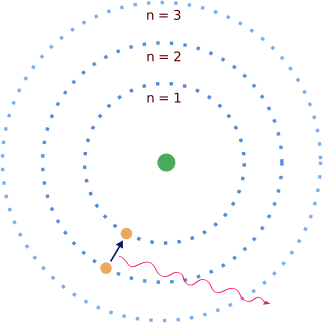
Almost alongside Rutherford's success, a young Dane named Niels Bohr, trying to correct errors in the planetary atomic model, added to it orbital levels, energy levels, jumps between orbits, and even the emission and absorption of light, which he assumed to be electromagnetic waves. With his work, Bohr took what had been a theoretical map for explaining certain phenomena and turned it into something that required filling blackboards to understand. As a result of his contribution to the structure of atoms, Niels Bohr won a Nobel Prize in 1922.
Bohr's atomic model
What followed Bohr was an almost endless list of brilliant minds. All of them added ever wilder theories about atoms —never seen before—, growing their mathematical apparatus to astronomical levels. To be honest, after hours of reading on the subject, looking at each atomic model was like looking at Santa Claus's sleigh: something outrageously publicized that no one has ever been able to see.
What exists at an atomic scale?
Given that atomic models are an imaginary map, a more honest question arises: has anything resembling an atom ever been seen? The short answer is uncomfortable: it depends on what we mean by seeing.
To explain it better, let's imagine we look at an apple: light bounces off its surface, reaches us, and forms its image in our eyes. But below about 200 nanometers that trick stops working: ordinary light no longer returns a portrait of what exists; it seems to pass around it without drawing it and carries on its way, as if the thing were translucent. Only a very special light —extremely intense, like the kind produced in the great particle accelerators— has managed to get close to that scale, and even so what it delivers are not photographs, but patterns: silhouettes and shadows.
Science, using every technology at its disposal, has come astonishingly far: it can locate fuzzy silhouettes, count them, arrange them one by one, measure the electric field at incredibly small scales. But each of those feats is a measurement dressed up as an image, not a direct look. What we today call "a photo of atoms" is still a map —far better than Thomson's or Bohr's, but a map after all—. And it must be said calmly, without drama: we have measured its trace with extraordinary precision; seeing them, in the plain sense in which we see an apple, not yet. And the same holds for almost everything very small or very far away.
A world without atoms
An almost far-fetched hypothesis, but a crucial one: what would happen if, faced with its implausibility, we decided to remove the atom in one stroke, to erase each of its models from the classrooms and from each and every branch of knowledge?
The first thing that would happen would be utter chaos in classrooms and education. Textbooks would have to be rewritten, erasing more than 200 years of history. Millions of pages would be left full of conceptual "holes", crossed-out words or forbidden terms that would make the texts utterly illegible. Schrödinger's equations, Lewis structures and molecular bond diagrams would lack a basic premise, turning into meaningless scribbles. Entire theses devoted to nanotechnology, nuclear physics or biochemistry would be invalidated at a stroke.
Science, for its part, would not stop: it would look for other paths —mathematical, philosophical— to explain what the atom used to explain. Because the world would still be made of the same thing. We would only have erased the map, not the territory.
Why does it matter?
However unlikely it may seem, behind all this effort —and thousands of people devoting entire lives to drawing the atom better— there is a wager: probing what matter is made of at a deeper level promises a universe full of possibilities.
The transmutation of the chemical elements could become viable. Nuclear reactors already turn elements such as uranium into plutonium and caesium. Bombarding lighter elements with particles can likewise turn them into heavier ones. Yet each of those transformations is extremely costly and impractical, and returns minuscule amounts on top of that. All of it is something that could change if we understood the process better and could control it at a lower level.
To put it as a joke, we could turn stones into gold or diamonds, fill the banks, and then turn them back into rocks; and even go further and create new chemical elements with new properties: materials that defy gravity, superconductors at high temperatures… a story without end.
The alchemists' dream
The second prize is already switched on, and not in a laboratory but in your home: a good share of the world's electricity comes from an enormous effort that lets us all enjoy it. Understanding matter better could open up ways of generating energy we do not yet know, far better and more efficient than today's. That is without setting aside the possibility of its use for non-peaceful ends, which has brought tragic results throughout history.
But not everything would bring tragedy. Behind this research lies the hope of improving technologies such as nuclear magnetic resonance imaging, indispensable for diagnosing illness; or of finding new ways to process information that could take future computers to undreamed-of limits. And, without doubt the most ambitious and imaginary of all, an old goal looms: to understand what time is and, perhaps, to control it.
The question hiding behind it
All of this explains why so many never put the pencil down and keep on researching. If a map as blurry and imaginary as the atom has already got us this far, how far would we go if we could understand and control matter at its lowest level?
Conclusion
In the end, my simulator remained a mere attempt. As you will have imagined, simulating an atom on a computer was like trying to catch butterflies blindfolded. Even so, all of it led me not only to take an interest in atoms and their imaginary models, but also to take on a whole universe of knowledge that once fascinated us and that, deep down, few of us really know.
Share this article
Pick a channel — or use your device's native share sheet.
https://www.astrocodex.org/en/article/atom/Content licensed under CC BY-NC 4.0.
Cookies & privacy
We use essential cookies to run the site (session, security, and your theme/language preferences). With your permission we also load embedded third-party content, such as YouTube videos. Cookie Policy